The Funding Channel 1306 Kings Highway, Brooklyn, NY 11229
Contact
sophia@thefundingchannel.com 516-451-1753
Reference
LTC-2026-11-24-BSA
From
Daniel Gavrilov, Founder, Limitless Technology Co
Date
November 24, 2026, revised November 25
Subject
AI bank statement analysis in Quickbase
Valid through
December 4, 2026
An underwriting profile on every deal in your Quickbase, live on new deals December 7
1. Executive summary
What you get
Every new deal's statements are read automatically. A month-by-month profile lands on the deal record: deposits, true revenue, balances, negative days, NSFs, and open and past positions.
What stays the same
Your team keeps shopping files. Your existing Quickbase lender-criteria filters keep working.
What we recommend
Option A (Core Bank Analysis) for December 7, then a two-week parallel run before Heron Data is switched off.
Working together
Daniel Gavrilov will work from your office Monday, November 30 to Wednesday, December 2, side by side with Sophia. Together you'll go through the sample deals, agree what counts as true revenue, and sign off the model choice at Gate 1, so the profile is exactly what your team wants before it goes live.
Price
Option A is $5,000 setup and $1,500 per month. Half the setup is paid on signing and half at go-live. AI processing is billed at cost during a 90-day pilot.
Secure checkout by Stripe. Payments are processed for Gav Capital, LLC, the parent company of Limitless Technology Co.
Live on new deals December 7, with Heron alongside until December 21
Dates assume kickoff by Monday, November 30
SetupNov 25 to 30Sign, pay, grant access, send sample deals
KickoffMon Nov 3050% of setup paid on signing
ExtractionNov 30 to Dec 2Read and check the sample files
Gate 1, extraction provenWed Dec 2
QuickbaseDec 2 to 4Write the fields, build the view
Gate 2, Quickbase demoFri Dec 4
Go-live prepDec 4 to 7Switch on for new deals
Gate 3, go-liveMon Dec 750% of setup due, monthly fee starts
Parallel runDec 7 to 21Compare with Heron daily
Final acceptanceMon Dec 21
Each gate needs your sign-off before the next phase starts. Daniel works on site with Sophia from kickoff through Gate 1, November 30 to December 2. Each day kickoff slips past November 30 moves go-live a day.
2. What we heard
Every application already lands in Quickbase. The bottleneck is turning four months of statements into numbers your team trusts, fast.
How a deal moves today
A rep sends the merchant a Jotform application link. Each rep's link carries a hidden field, so the deal is credited to them.
The merchant completes the application and uploads the last four months of business bank statements. A first submission can run to about 60 pages.
The record is created in Quickbase and the statements are stored in Box.
Heron Data parses the statements and writes results back to Quickbase. It also matches the deal to lender criteria, submits it, and logs lender replies.
Reps can switch a deal to manual submission and shop it from the lender-eligibility view in Quickbase.
What you told us
You want a profile you can read at a glance: deposits, ending and average balances, negative days, NSFs, and who the merchant has borrowed from, past and present.
Your team will keep shopping files itself. You don't need AI to shop deals, and you don't need marketing.
Submissions sent through the current setup have not been reaching lenders. One recent file was submitted five times, including manually, with no response. Shopped outside the system, it was approved quickly by a lender you already work with. The cause hasn't been identified.
You plan not to renew Heron Data at the start of December.
3. Phase 1: bank statement analysis in Quickbase
Within 10 minutes of statements arriving, each deal gets a month-by-month profile on its Quickbase record. Any figure we can't verify is flagged instead of written.
Field
What it shows
Deposits
Total dollars and number of deposits, per month
True revenue
Deposits minus transfers between the merchant's own accounts, loan and advance proceeds, and returned items
Withdrawals
Total dollars per month
Balances
Beginning, ending and average daily balance, per month
Negative days
Days the balance closed below zero, per month
NSFs
Count of non-sufficient-funds and overdraft charges, per month
Open positions
Lender, payment amount, frequency (daily, weekly, monthly) and estimated monthly total
Closed positions
Prior lenders whose payments stopped during the statement period
Four-month summary
Averages and totals used by your lender-criteria filters
What counts as true revenue is agreed with your team at Gate 1, before anything goes live.
How it works
Statements land in Box and the deal record is created in Quickbase. Our service picks up the new deal automatically.
AI reads each statement and extracts its transactions and balances.
Rule-based logic, not AI, classifies the transactions and calculates every figure above.
Each statement is checked against its own printed totals: beginning balance plus credits minus debits must equal the ending balance. A statement that doesn't reconcile, or a missing month, flags the deal for human review.
Results are written to fields on the deal record through Quickbase's API, using a dedicated service user. Heron Data writes to your Quickbase the same way today. We map to the fields Heron fills wherever possible, so your lender-criteria filters and shop view keep working.
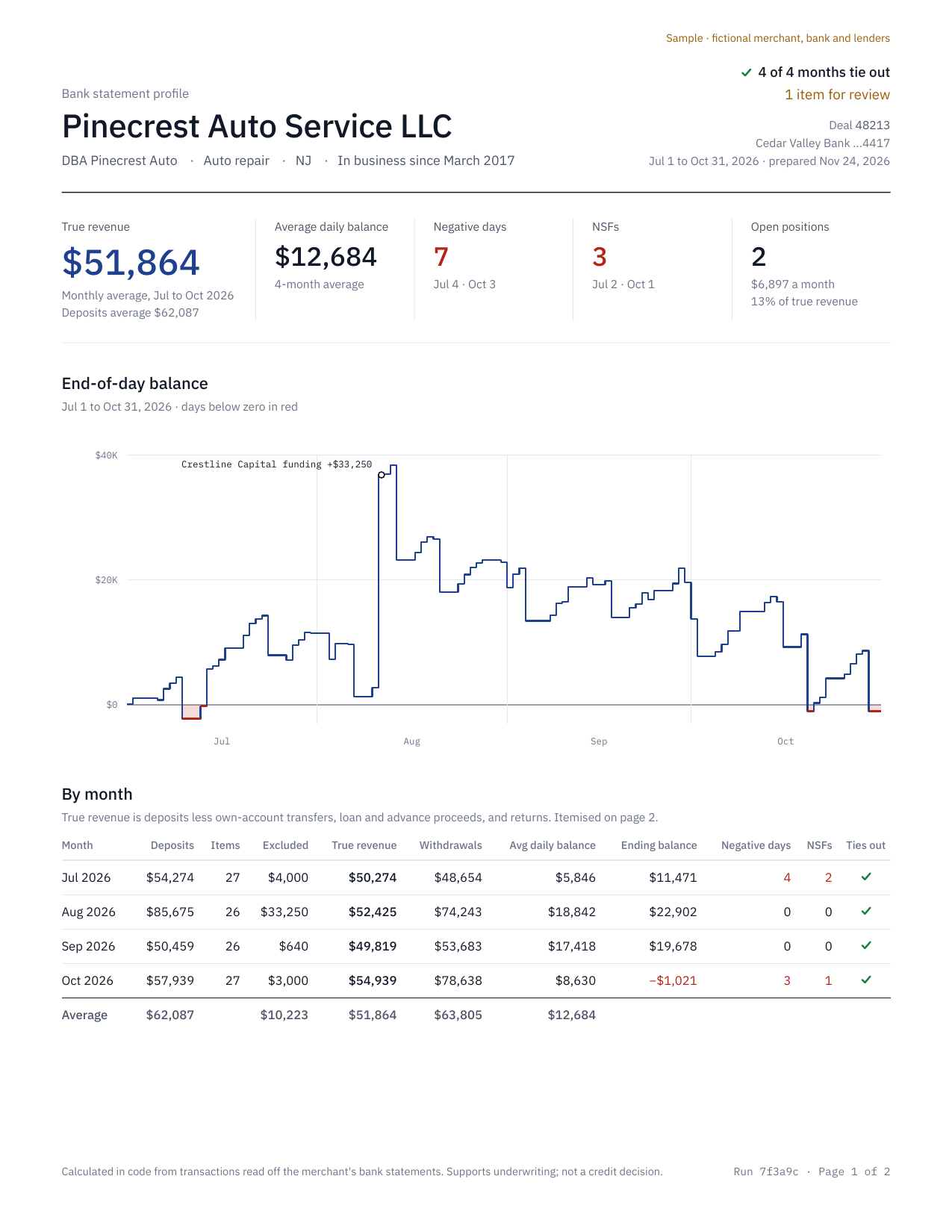
A Bank Analysis button on the record opens the monthly table and positions. Every deal also gets a two-page PDF profile, attached to the record automatically and ready for lender packages: headline figures, a daily balance chart, monthly figures, positions, everything left out of revenue, and how each statement was checked.
Every extracted figure records the file and page it came from, so an underwriter can check it in seconds.
Page 1 of the PDF profile, shown with a fictional merchant, bank and lenders. Page 2 lists positions, items for review, every deposit left out of true revenue, and how each statement was checked.
4. Options and payment
We recommend starting with Option A on December 7. Each option builds on the one before, so you can upgrade later and pay only the difference in setup. To accept, sign by paying the first 50% of setup for the option you choose.
Recommended for December 7
A. Core Bank Analysis
Phase 1 as described in section 3: statement analysis written to Quickbase, the Bank Analysis view, and a two-page PDF profile on every deal.
Option A, plus a DataMerch check by FEIN at intake, a court and judgment search where records are accessible, and a short industry and business research summary on the profile.
Option B, plus lender-reply tracking (reads lender emails, logs offers and declines with reasons in Quickbase, alerts the rep) and pre-filled application links.
Each button opens Stripe's secure checkout in a new tab and takes one payment. Enter The Funding Channel's legal business name at checkout. Payments are processed for Gav Capital, LLC, the parent company of Limitless Technology Co. All prices are in US dollars.
The monthly fee covers hosting, monitoring, maintenance, model updates and business-hours support.
AI processing is billed at cost for the first 90 days, then at a fixed per-deal rate. Section 5 explains what it covers, what it should cost and how we choose the model.
Third-party data (your DataMerch subscription, any paid public-records source) is billed to you directly or passed through at cost.
Pre-filled links in Option C use Jotform's Prefill feature, which keeps merchant data inside a secure token rather than visible in the link.
A security assessment and penetration test can be quoted separately.
5. AI processing: what you're billed for and how we pick the model
Each deal's statements are read by Claude, an AI model from Anthropic. Anthropic charges by the amount of text a model reads and writes, so the cost of a deal depends on how many pages it has and how many transactions are on them. For the first 90 days we pass that charge through to you at cost, with no markup.
What you're billed for
Anthropic's charge for processing your deals, and nothing else. Hosting, monitoring and support are covered by the monthly fee.
Each month you get a usage report showing deals processed, pages read, the model used and the cost per deal. It comes from our run log, which records the cost of every deal, and we check it against Anthropic's billing before we invoice.
Recalculating a deal after a rule change reuses the transactions already read, so it adds no processing cost.
Your processing runs under a monthly spending limit that you approve. We tell you well before it is reached, so no deal is held up without warning.
What it should cost
We estimate a typical 60-page deal at $0.40 to $0.90 on Claude Sonnet 5.5, or 2 to 6 cents on Claude Haiku 5.5. Scanned or photographed statements cost more to read than statements downloaded from online banking. A deal made up entirely of scanned pages comes to about $1.10 on Sonnet.
Deals per month
Claude Sonnet 5.5
Claude Haiku 5.5
250
$100–$225
$5–$15
500
$200–$450
$10–$30
1,000
$400–$900
$20–$60
Estimates at Anthropic's published prices on November 24, 2026: Sonnet 5.5 at $2 per million tokens read and $10 per million written; Haiku 5.5 at $0.10 and $0.50. If Anthropic changes its prices, the at-cost charge follows.
Why at cost for 90 days
The real cost depends on your volume and on how many statements arrive scanned, which no one can know until live deals run. Billing at cost means you never pay for a padded estimate. After 90 days we set a fixed per-deal rate from the measured cost, so your bill becomes predictable.
How we choose the lowest-cost model that does the job
A cheaper model is only worth using if it is accurate enough for underwriting, so we choose by testing on your own deals, not by price alone.
We run the 10 to 20 past deals your team verified through each candidate model, starting with the lowest-cost one, Claude Haiku 5.5, then Claude Sonnet 5.5. We ask for a set that covers at least four banks, scanned statements, a deal with two accounts, stacked positions, and negative days and NSFs.
Each model is scored against the go-live tests in section 6: deposits and balances exact, true revenue within 2%, every open position found, and every problem statement flagged.
We use the cheapest model that passes every test. If Haiku passes on downloaded statements but not on scanned ones, only the scanned pages go to Sonnet.
At Gate 1 (December 2), you see each model's results and cost per deal side by side, and you sign off on the choice.
When Anthropic releases a new or lower-cost model, we put it through the same test and switch only if it passes and you approve.
Whichever model is used, every statement must still reconcile to its own printed totals. A misread figure fails that check and is flagged for review, never written as verified. We test only models that meet the data-retention terms in section 8.
6. Acceptance criteria
Go-live and final sign-off are each tested against past deals your team has already verified, not against our own numbers.
To go live (Gate 3), on a test set of at least 10 past deals
Monthly deposit totals and ending balances match the statements exactly on every statement that reconciles.
True revenue is within 2% of your team's figure on each deal.
Every open position your team identified is found, with the right lender and payment amount.
Every statement that doesn't reconcile, and every missing month, is flagged. None is written as if verified.
Results reach Quickbase within 10 minutes of statements arriving.
For final acceptance (December 21), your team spot-checks 20 live deals from the parallel run against the same criteria. We fix and re-test any miss before sign-off.
7. Moving off Heron Data
Keep Heron running until Phase 1 passes final acceptance on December 21, because Heron does more than parse statements.
Today Heron also matches deals to lender criteria, submits them, reads lender replies, logs offers and declines with reasons, and alerts reps.
Option A replaces the statement parsing only. Submissions stay with your team. Lender-reply tracking needs Option C or a manual process once Heron is off.
Ask Heron for a month-to-month extension or a short notice period instead of a full renewal.
Our results map to the same Quickbase fields Heron fills today, so the cutover is a switch, not a rebuild.
The undelivered-submission issue is separate from this build. Once we have Quickbase access, we can investigate it as a separate diagnostic.
8. Data security
Applications and statements carry Social Security numbers, tax IDs and account data. Phase 1 keeps that data in your systems and out of ours wherever possible.
Source documents stay in your Box, and results are written to your Quickbase. We delete our working copies of statements within 7 days of processing.
We connect through dedicated service accounts with the least access the job needs. No shared personal logins. Credentials live in a secrets manager, never in browser code.
Data is encrypted in transit and at rest.
AI providers are used under business terms that exclude training on your data, with zero data retention where the provider offers it.
An audit log records every document processed and every field written.
If we discover an incident affecting your data, we notify you immediately.
The analysis supports your underwriting. It does not make credit decisions, and Limitless Technology Co is not a lender or broker.
9. What we need from you
December 7 holds only if these are in place by Monday, November 30.
Your chosen option, with 50% of setup paid on signing through section 4 ($2,500 for Option A)
A desk at your office for Daniel, Monday, November 30 to Wednesday, December 2, and time with Sophia on those days
A Quickbase user for us with builder access to the deals app, plus a dedicated service user for API access
Access to the Box folder where statements are stored (your Box admin approves our API app)
10 to 20 past deals with their statements and the figures your team verified
A list or screenshot of the Quickbase fields Heron fills today
Heron's renewal date and notice terms, and its monthly cost if you're willing to share it
Your average number of applications per day
The name of the person who approves gate sign-offs and invoices. Sophia Brooks is the day-to-day contact.
Option B only: a DataMerch account with API access
Option C only: Jotform admin access, and access to the inbox where lender replies arrive
10. Out of scope
This proposal covers the bank analysis and the add-ons in Options B and C. The following are excluded:
Submitting deals to lenders. Your team keeps shopping files.
Marketing, lead generation and SMS. You already have texting in place.
Changes to the OnDeck pre-underwriting inside Quickbase.
Diagnosing and fixing the undelivered-submission issue. This is available as a separate diagnostic.
Replacing Quickbase or migrating to another CRM.
When you're ready, a later phase could add AI-assisted lender matching built on your lender guidelines. It would use the Phase 1 profile as its input.
11. Commercial terms and how to accept
Setup is paid in two equal parts. The first 50% is due on signing, paid through the Sign and pay buttons in section 4 or below. The second half is invoiced at go-live (Gate 3), once the go-live tests in section 6 pass. The monthly fee starts at go-live and is billed monthly.
After the 90-day pilot, service runs month to month. Either side can cancel with 30 days' notice.
Work outside this scope is quoted in writing before it starts.
You own your data and the results. A short services agreement will cover confidentiality, intellectual property and liability.
This proposal is valid through December 4, 2026. The dates assume acceptance by November 30. A later start moves every gate by the same number of days.
How to accept
Sign and pay. Choose your option and pay 50% of its setup on signing, through Stripe checkout.
Daniel Gavrilov emails you within one business day to schedule kickoff and request system access. To hold December 7, send the items in section 9 by November 30.